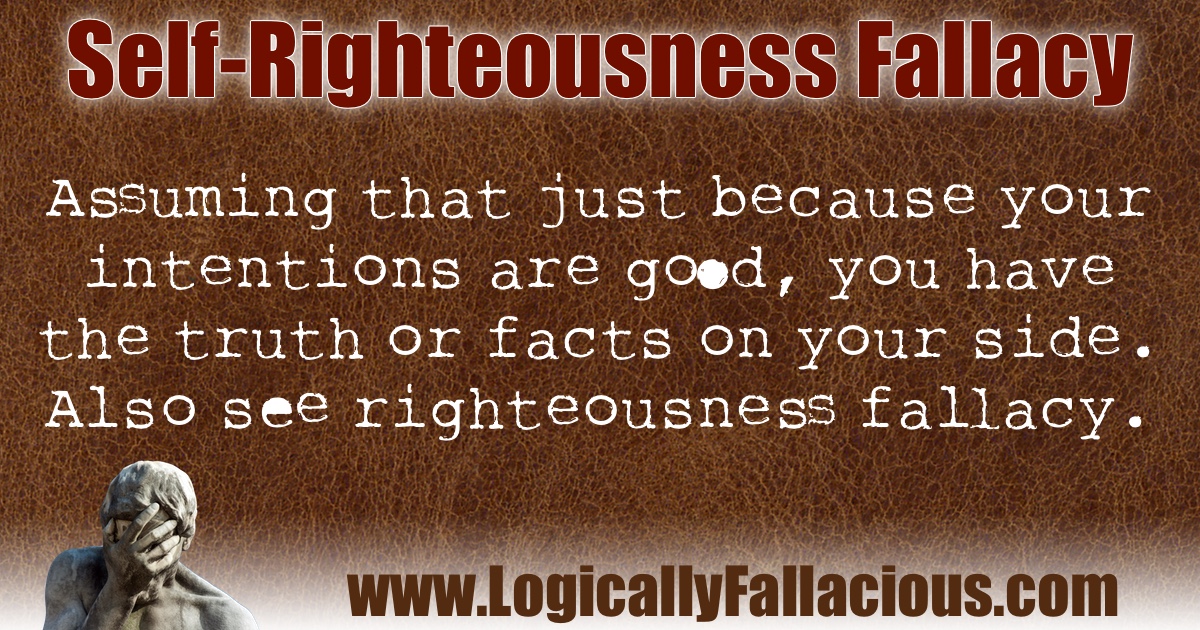
Self-Righteousness Fallacy
Description: Assuming that just because your intentions are good, you have the truth or facts on your side. Also see righteousness fallacy.
Logical Form:
You make claim X.
You have good intentions.
Therefore, X is true.
Example #1:
Ricki: Do you think aborted fetuses have feelings?
Jenni: Any honorable and kind person would have to say they do have feelings. So yes.
Explanation: Jenni might be the queen of honor with kindness oozing from her puppy-dog eyes, but these qualities are independent of one’s ability to know facts or come to an accurate conclusion based on available data.
Example #2:
Jenni: Is a fetus a human being?
Ricki: No, because I am not a monster and would never suggest killing an unwanted human being is okay.
Explanation: Ricki is making a claim about a fetus and using the fact that she is “not a monster” to support the claim, which is independent of her intentions.
Exception: This relates to facts, not subjective truth. We can use the idea of righteousness to conclude how we feel about something or someone. For example,
Jenni: Do you consider a fetus to be as valuable as a human being?
Ricki: No, because I am not a monster and would never suggest killing an unwanted human being is okay.
Fun Fact: Self-righteous is defined as having or characterized by a certainty, especially an unfounded one, that one is totally correct or morally superior. The self-righteousness fallacy follows a more generic definition of being correct because of “good intentions.”
References: This a logical fallacy frequently used on the Internet. No academic sources could be found.
Questions about this fallacy? Ask our community!

Master Logical Fallacies Online
Take the Virversity course and sharpen your reasoning skills with structured lessons.
View Online Course