"Pooh Pooh" Fallacy.
Historical archive only. New interaction is disabled.
Original Question
I looked at some of the fallacies at wikipedia and this one is called the , "pooh pooh" fallacy, https://en.wikipedia.org/wiki/Pooh-pooh#:~:text=A%20pooh%2Dpooh%20(also%20styled,the%20substance%20of%20the%20argument. It#s where an arguer labels an argument as, "a waste of time" or, "not worth considering" but i am not too sure whether is already in the book (as in if there is another word for it) or if it even is fallacious at all.
Related: See the archive Definition discussion and the Strawman Fallacy entry.
Comments on Question
Right in the wikipedia post it says "Authors have characterized the fallacy as a form of a straw man fallacy, where an argument is described as inherently worthless or undeserving of serious attention."
I agree that is a form of the Straw Man’s argument, in which an argument is purposefully misrepresented to make it easier to attack. However, whereas the strawman restates the initial claim in a distorted way and attacks it, the pooh-pooh argument does not address any arguments, but merely ridicules it. One might poo-pooh an argument outright, or agree with a point in general but then disagree about the specific case in hand.
Answers
4I don't think it's a straw man - the argument is just described as beneath consideration (subjective and defensible claim, but requires further reason/evidence) rather than being distorted (somewhat objective - you can compare the original argument, and its counterpart, to see if any irrelevant objections have been raised).
It seems to fit under appeal to the stone. The argument is simply dismissed as being absurd, a waste of time, or something else, without reason or evidence (also check out the 'related theories' section of that page).
This one is a bit nuanced though, because sometimes, a conclusion is obviously true/untrue (e.g. the Earth being an oblate spheroid).
Seems like a form of appeal to ridicule, which is when one asserts that an argument is unworthy of consideration because it's absurd. The fallacy you cited as described by Wikipedia states "a rhetorical device in which the speaker ridicules an argument without responding to the substance of the argument." This corresponds with the definition of the appeal to ridicule.
First of all, Wikipedia is NOT a reliable resource. Period. While it has improved over the years from the time when THE ONION relentlessly shamed it into taking drastic action with headlines like this:
Wikipedia Celebrates 750 Years Of American Independence http://www.theonion.com/articles/wikipedia-celebrates-750-years-of-american-indepen,2007/ via @TheOnion
The basic flaw of the site is that even its founderJimmy Wales has stated openly he is less interested in the truth than what can be cited, and we all know that today there is no end to published misinformation and nonsense that can be cited by someone somewhere of dubious bona fides.
Besides, there is no reason not to investigate a subject further except out of pure intellectual laziness. There are plenty of truly scholarly references to be found by just scrolling down a little further.
As far as pooh-poohing a claim, the strawman definition does not match because it requires a distortion of the original assertion or supplanting a deceptive one in its place.
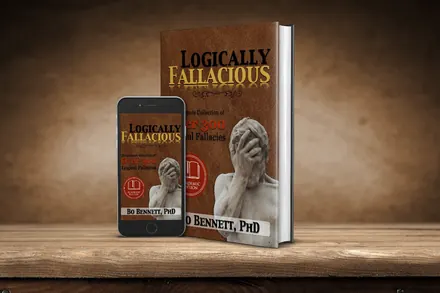
See Dr. Bo's definition:
Strawman Fallacy
Description: Substituting a person’s actual position or argument with a distorted, exaggerated, or misrepresented version of the position of the argument.
Logical Form:
Person 1 makes claim Y.
Person 2 restates person 1’s claim (in a distorted way).
Person 2 attacks the distorted version of the claim.
Therefore, claim Y is false.
Pooh-poohing is just a blunt dismissal of the claim, and more than likely with a thought-terminating cliché like, Now, you've really wandered off the reservation, or oh, c'mon, that hasn't been relevant for decades. It's not addressing the facts or elements of the claim, but actually backhandedly dismissing it outright, while humiliating the claimant
I would submit it to be a form of argumentum ad fidentia, or, as Dr. Bo explains:
Attacking the person’s self-confidence in place of the argument or the evidence.
Without a hard example, we can only supply our own suppositions. I suppose this could be a Thought-terminating Cliché (also known as a semantic stop-sign, a thought-stopper, bumper sticker logic, or cliché thinking), which is a form of loaded language. Its use can be by one quelling cognitive dissonance or a person outright wanting to avoid the responsibility of thought regarding the subject under discussion.
Depending on the context using the phrase (or cliché), it may be valid and not qualify as thought-terminating. However, it is thought-terminating when its application dismisses dissent or justifies fallacious logic. Its only function is to stop an argument from proceeding further. In other words, "end the debate with a cliché... not a point."
{Robert Jay Lifton popularized the term in his 1961 book “Thought Reform and the Psychology of Totalism,” he called the use of the cliché, along with "loading the language" as "The language of Non-thought.”}
Master Logical Fallacies Online
Take the Virversity course and sharpen your reasoning skills with structured lessons.
View Online Course
It may be, but even if I mean there are multiple fallacies in the book that are agreed (even by the author) to be either related or be a form of fallacy x. My main question kinda lies on whether it is appropriate to include this?