Fake Precision
(also known as: over-precision, false precision, misplaced precision, spurious accuracy)
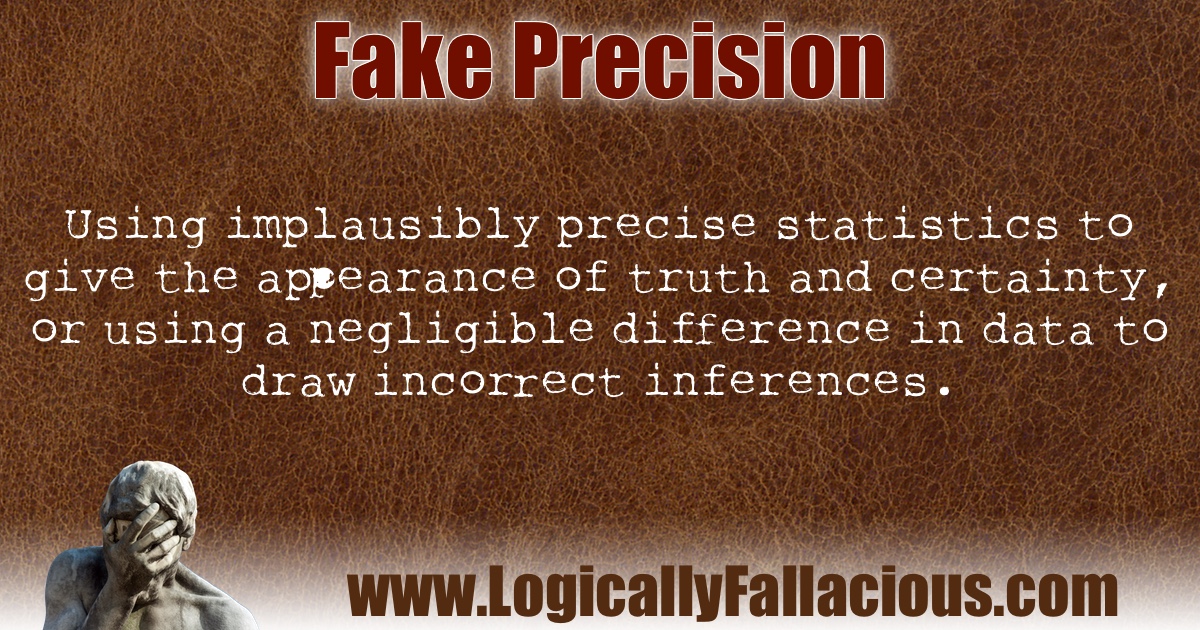
Description: Using implausibly precise statistics to give the appearance of truth and certainty, or using a negligible difference in data to draw incorrect inferences.
Logical Forms:
Statistic X is unnecessarily precise and has probability A of being true.
Statistic X is interpreted as having probability A+B as being true.
Statistic X represents position A.
Statistic Y represents position B.
Statistic Y is insignificantly different from statistic X.
Position A is seen as significantly different from position B.
Example #1:
Tour Guide: This fossil right here is 120,000,003 years old.
Guest: How do you know that?
Tour Guide: Because when I started working here three years ago, the experts did some radiometric dating and told me that it was 120,000,000 years old.
Explanation: Although more of a comedy skit than anything else, this demonstrates the fallacious reasoning by the tour guide in her assumption that the dates given to her were precise to the year.
Example #2:
The difference between first and second in many cases is negligible, statistically, yet we give those differences artificial meaning. Who was the second person to walk on the moon... just minutes after Neil Armstrong? Does anyone remember who the second fastest man in the world is, even though he might come in .01 seconds after the first place winner?
Explanation: We often artificially assign significant meaning to tiny statistical differences. It is a fallacy when we infer that the first place runner is “much faster” than the second place runner, even though the difference is .01 seconds.
Exception: In reality, tiny statistical differences can have a significant impact, regardless of our interpretation. For example, jumping out of the way of a car .01 seconds too late can mean the difference between a close call, and death.
Tip: Don’t confuse fake precision with real performance.
References:
Questions about this fallacy? Ask our community!
Master Logical Fallacies Online
Take the Virversity course and sharpen your reasoning skills with structured lessons.
View Online Course