Is the failure to accept Objective Reality a fallacy?
Historical archive only. New interaction is disabled.
Original Question
Many times, when "discussing" fallacious reasoning, and usually at the end of the discussion, I have noticed that many people will use this method in an attempt to short-circuit the reasoning/debate process.
Common statements include:
"Well, that depends upon how you define (BLANK). To me, it means..."
"That's how YOU see it. Everybody's different."
They feel that if they choose a critical word/term used in the discussion and deny the existence of an objective definition for that word, they can make it, and their argument, mean whatever they want.
Common statements include:
"Well, that depends upon how you define (BLANK). To me, it means..."
"That's how YOU see it. Everybody's different."
They feel that if they choose a critical word/term used in the discussion and deny the existence of an objective definition for that word, they can make it, and their argument, mean whatever they want.
Answers
2Agreed...
I probably should've articulated this question more clearly.
These issues come up when discussing more primary philosophical terms, even basic axioms.
The most classic example I can think of is Bill Clinton: "That depends upon what your definition of the word "is" is..." during his impeachment.
Another somewhat similar statement, during the Nye/Ham debate (I think), was "If God told me that 2+2=5, then I would believe it and try to understand how it's true."
Both are obviously attempts at defining all of reality as subjective.
Of course, there are and always will be words that are subjective for a variety of reasons; however, what I'm speaking of goes much deeper than interpretation and touches on insanity.
It's almost as if they are trying to make the relationship between language and reality reversed. They believe that if they define something differently, even existence itself, then the reality of the situation/their argument magically changes to fit their desires.
I probably should've articulated this question more clearly.
These issues come up when discussing more primary philosophical terms, even basic axioms.
The most classic example I can think of is Bill Clinton: "That depends upon what your definition of the word "is" is..." during his impeachment.
Another somewhat similar statement, during the Nye/Ham debate (I think), was "If God told me that 2+2=5, then I would believe it and try to understand how it's true."
Both are obviously attempts at defining all of reality as subjective.
Of course, there are and always will be words that are subjective for a variety of reasons; however, what I'm speaking of goes much deeper than interpretation and touches on insanity.
It's almost as if they are trying to make the relationship between language and reality reversed. They believe that if they define something differently, even existence itself, then the reality of the situation/their argument magically changes to fit their desires.
A few years back I got into a long debate where I held the position that the God of the Bible supported genocide. Despite countless references to top encyclopedias, dictionaries, and even past historical events where the word was used, my opponent refused to accept that genocide included extermination based on religious ideology. It was frustrating and a bit unsettling to see how an otherwise bright person can deny something so "objective" such as a commonly accepted definition in order to maintain his belief in a perfectly benevolent deity.
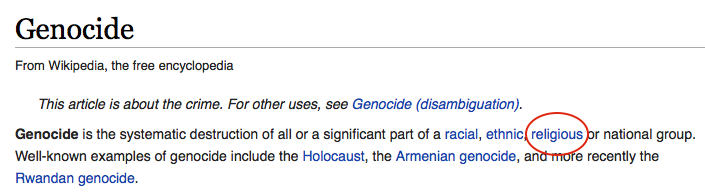
Failing to accept such an established fact is certainly a flaw in reasoning, but it might not be if the person is acknowledging the use of the definition, but arguing that another definition is also used, and in a sense, still "objective." For example, if someone argues against gay marriage because marriage is between a man and a woman according to Noah Webster's definition, from An American Dictionary of the English Language (1828):
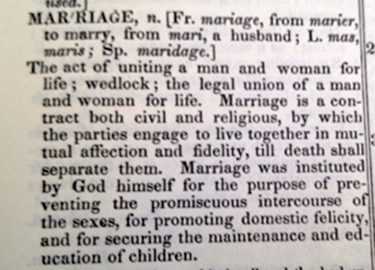
He or she would be correct—in 1828. The opponent would have to acknowledge that accepted definition for that era, and argue that it is no longer relevant. In such a case, saying "It depends on how you define marriage" is not such a fallacious thing to say, because of the controversy surrounding the word and the recent changes to the definition.
In summary, agreeing upon what is "objective reality" can be tricky. As always, make sure you have the facts on your side, and not just ideology.
Failing to accept such an established fact is certainly a flaw in reasoning, but it might not be if the person is acknowledging the use of the definition, but arguing that another definition is also used, and in a sense, still "objective." For example, if someone argues against gay marriage because marriage is between a man and a woman according to Noah Webster's definition, from An American Dictionary of the English Language (1828):
He or she would be correct—in 1828. The opponent would have to acknowledge that accepted definition for that era, and argue that it is no longer relevant. In such a case, saying "It depends on how you define marriage" is not such a fallacious thing to say, because of the controversy surrounding the word and the recent changes to the definition.
In summary, agreeing upon what is "objective reality" can be tricky. As always, make sure you have the facts on your side, and not just ideology.

Master Logical Fallacies Online
Take the Virversity course and sharpen your reasoning skills with structured lessons.
View Online Course